
Direct Edge Computing in Zone 1
Core Value & Usefulness Rundown
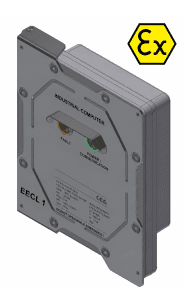
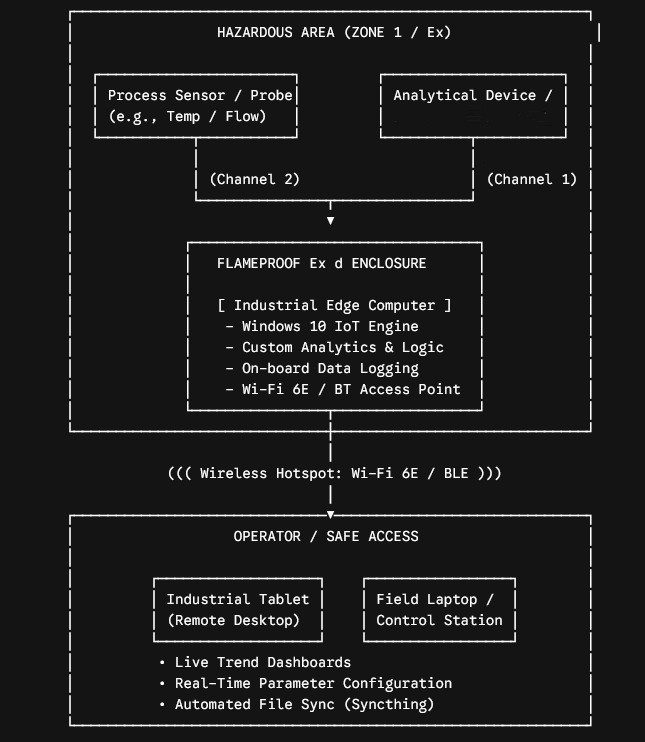
Direct Edge Computing in Zone 1: Certified as an II 2G Ex db IIB T4 Gb flameproof unit, eliminating the need to run long, costly signal cables back to a safe area control room.
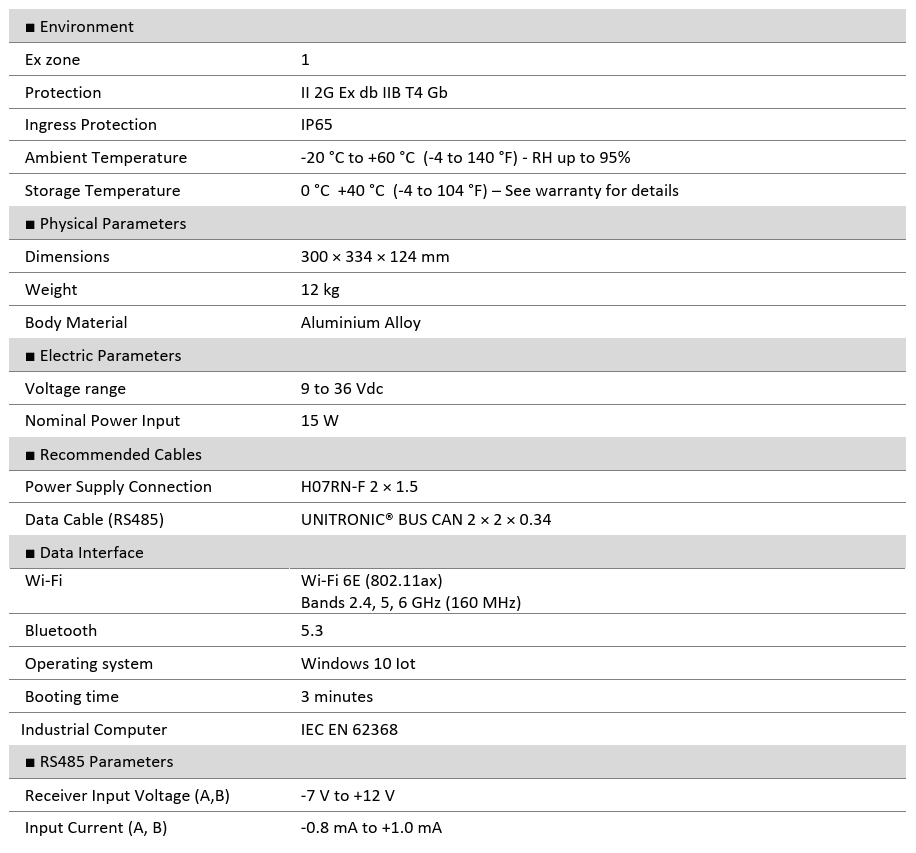
Wireless Interfacing Without Opening the Box: Built-in Wi-Fi 6E (2.4/5/6 GHz) and Bluetooth 5.3 generate a localized wireless hotspot. Operators can view real-time data, adjust parameters via Remote Desktop (RDP), or automatically sync log files (via Syncthing) using any field tablet or laptop without hot work permits or breaking the enclosure seal.
Open Architecture Flexibility: Running full Windows 10 IoT, it isn’t locked into proprietary, rigid firmware. End users can deploy custom logic, supervisory software, SCADA clients, or custom datalogging scripts.
Multi-Instrument RS-485 Integration: Features dual independent RS-485 interfaces to aggregate data from multiple analytical devices, probes, or field transmitters simultaneously.
Industrial-Grade Reliability: Wide 9–36 V DC power input, low 15 W power draw, IP65 ingress rating, and a rugged operating range of -20°C to +60°C.
EECL 1 – THE MISSING COMPUTING LAYER FOR HAZARDOUS-AREA INSTRUMENTATION
The EECL 1 Zone 1 Flameproof Industrial Edge Computer & Datalogger is designed to fill a common gap in hazardous-area instrumentation: the field device is already installed and performing its measurement, but additional data, calculations, comparisons, logging, or processing are needed to make that measurement truly useful to the customer.
In many installations, sensors, analyzers, transmitters, detectors, and other instruments operate as independent devices. They provide valuable raw measurements, but the instrument itself may have limited ability to combine its reading with information from other devices.
Traditionally, solving this problem may require sending multiple signals back to a PLC, DCS, SCADA system, or computer in the control room. In an existing hazardous-area installation, this can mean additional long cable runs, cable trays, barriers, junction boxes, I/O modules, engineering work, and modifications to the existing control system.
The EECL 1 provides another approach: Bring the computer to the instruments instead of bringing every instrument signal back to the computer.
LOCAL COMPUTING DIRECTLY IN THE HAZARDOUS AREA
The EECL 1 provides a Windows-based computing platform that can be installed close to compatible field instruments in a Zone 1 hazardous area.
Data from multiple nearby instruments can be brought together locally:
- Sensor A + Sensor B + Analyzer + Transmitter + Other Instrument
↓
EECL 1 Zone 1 Computer
↓
Collect • Calculate • Compare • Correct • Analyze • Log • Trend • Report
↓
Remote Access to Process Information
Because the EECL 1 is a computer rather than a single-purpose instrument, its function is not limited to one particular measurement technology.
The application can be developed around the customer’s actual process requirement.
Specifications
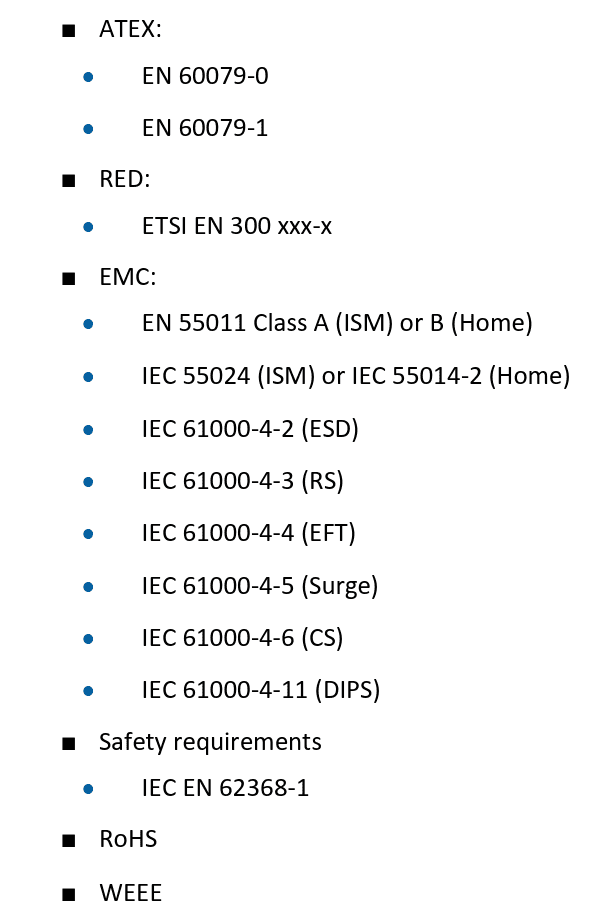
Standards, Directives & Certifications
TURN RAW INSTRUMENT DATA INTO USEFUL PROCESS INFORMATION
A field instrument may provide only one piece of the information needed to understand a process.
For example:
- Analyzer Reading + Temperature
can produce a temperature-compensated result. - Gas Sensor + Ventilation Status
can provide additional information for environmental or process monitoring. - Vibration Sensor + Motor Temperature
can provide a more complete picture of machine condition. - Level Sensor + Pump Status
can be used to analyze filling, emptying, or pump operation. - Moisture Analyzer + Product Temperature
can provide corrected or contextualized moisture information. - Two Similar Sensors
can be continuously compared to identify deviation between measurements. - Analyzer + Sample Conditions + Equipment Status
can create a complete timestamped record of what was happening when each measurement was taken.
The value of the EECL 1 is therefore not simply in collecting another signal. It is in creating relationships between measurements that previously existed independently.
AREAS OF APPLICATION
- Time-Based Calculations
Calculate operating duration, equipment runtime, process duration, time above or below a threshold, and other time-related information. - Event Logging
Create timestamped records when particular process conditions, instrument states, or measurement changes occur. - Process Trending
Turn individual readings into historical trends that can help operators understand how the process changes over minutes, hours, days, or longer periods. - Data Filtering & Smoothing
Process noisy raw measurements using software-based averaging, filtering, or other appropriate algorithms. - Unit Conversion & Scaling
Convert raw instrument values into the engineering units or formats required by the customer. - Custom Data Processing
Run application-specific formulas or software routines that may not be available within the original field instrument. - Combined Process Monitoring
Bring together unrelated measurements—such as temperature, humidity, concentration, vibration, level, equipment status, analytical results, or other process variables—to provide a more complete picture of operating conditions. - Local Historical Database
Maintain process records close to the measurement point for troubleshooting, engineering studies, maintenance, quality analysis, or operational review. - Remote Data Retrieval
Allow authorized personnel to retrieve logged information or access the computer remotely without routinely opening the hazardous-area enclosure.
- Multi-Instrument Data Logging
Collect measurements from several compatible instruments and store them together with synchronized timestamps. - Mathematical Calculations
Perform addition, subtraction, multiplication, division, ratios, percentages, averages, equations, conversion formulas, and other user-defined calculations. - Instrument Comparison
Continuously compare readings from two or more sensors to determine deviation, agreement, or measurement differences. - Reference Measurement Correction
Use data from a secondary instrument to correct, compensate, or contextualize the primary measurement. - Calculated / Virtual Measurements
Create new process values mathematically from several existing measurements without requiring a dedicated instrument for every derived value. - Minimum, Maximum & Average Tracking
Automatically record minimum, maximum, moving average, and long-term average values. - Rate-of-Change Monitoring
Determine how quickly a measurement is increasing or decreasing rather than monitoring only its instantaneous value. - Deviation Tracking
Calculate and record the difference between a measurement and a reference value, target, baseline, or another instrument. - Threshold & Conditional Processing
Perform calculations, logging, or other software actions when defined process conditions occur.
SOLVING THE “ONE MORE MEASUREMENT” PROBLEM
A common situation occurs after an instrument has already been installed.
The customer initially requires: Instrument A → Measurement A
After operating the system, they realize: “Measurement A is useful, but we also need Measurement B to properly interpret it.”
Later they may require Measurement C, a mathematical calculation, historical trending, comparison against another sensor, or automatic data logging.
The requirement becomes:
- Instrument A + Instrument B + Instrument C
↓
EECL 1
↓
Combined and Processed Information
This is where the EECL 1 becomes particularly valuable. Instead of replacing an otherwise functional instrument simply because it lacks advanced computing capability, the EECL 1 can provide the additional computational layer around the existing instrumentation.
ONE COMPUTER – MANY POSSIBILITIES
The EECL 1 is not limited to one sensor type or one calculation.
Its Windows-based architecture provides the flexibility to develop applications for:
- Datalogging
- Mathematical Calculations
- Sensor Comparison
- Compensation
- Trending
- Data Conversion
- Deviation Tracking
- Averaging
- Min/Max Recording
- Conditional Logic
- Event Logging
- Data Validation
- Custom Algorithms
- Instrument Diagnostics
- Process Analysis
This makes the EECL 1 particularly suitable for:
- Oil & Gas
- Chemical
- Petrochemical
- Pharmaceutical
- Scientific Environmental
- Manufacturing
- Utilities
And other hazardous-area applications where multiple instruments need to work together locally.